


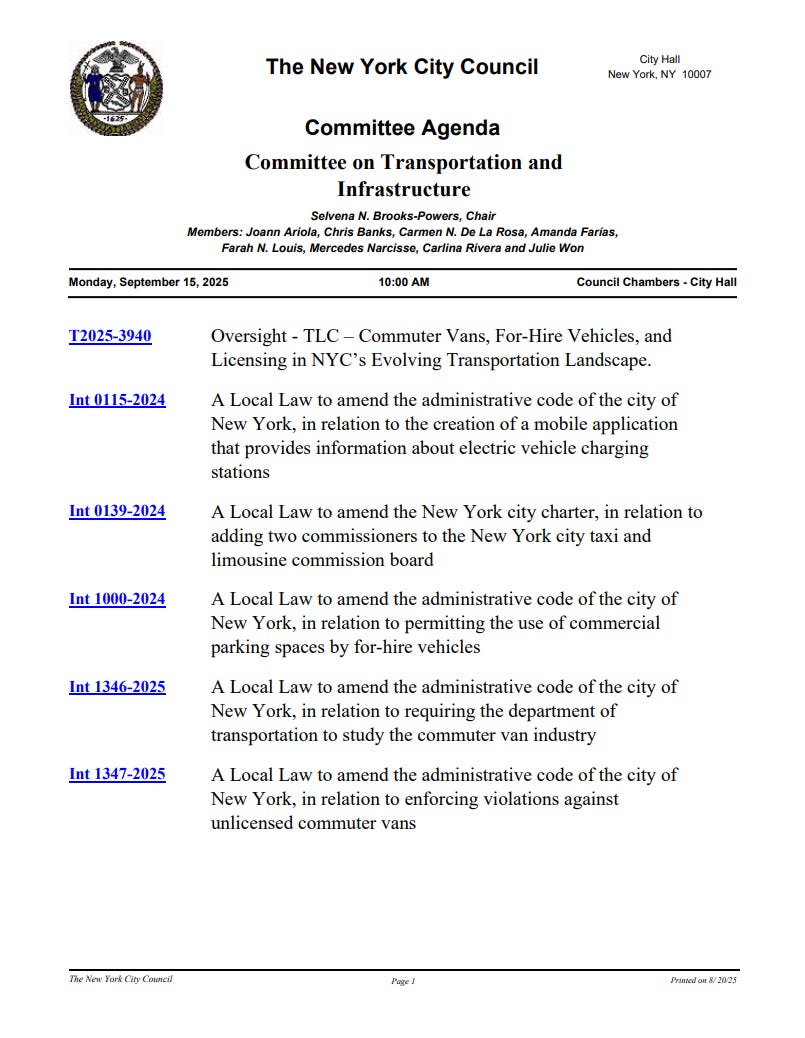
This upcoming Monday, September 15th, at 10am, the City Council will open hearings on a slate of bills that could reshape how taxis, for-hire vehicle (FHVs), and commuter vans (1,2) operate in New York City.
From granting FHVs access to commercial parking space to expanding the TLC Board with two additional seats for licensed drivers, the proposals address long-standing driver concerns. Proposed legislation could eventually have major implications for city curb space, enforcement, and potentially the value of TLC plates and medallions.
The City Council committee will consider five bills.
Int. 0115-2024 (Alexa Avilés): Requires the city to develop a public mobile app showing EV charging stations, with real-time availability and e-bike compatibility details.
Int. 0139-2024 (Selvena N. Brooks-Powers): Expands the TLC Board from nine to eleven seats, adding two Mayor-appointed commissioners who must hold TLC driver licenses.
“This bill would increase the size of the Taxi and Limousine Commission (TLC) board from nine to eleven commissioners. The two additional commissioners would be required to hold a valid TLC driver license and would be appointed by the Mayor, with the advice and consent of the Council.”
- Int. 2247-2021 (proposed to NYC Council in 2021)
Int. 1000-2024 (Justin L. Brannan): Permits for-hire vehicles (FHVs) to use commercial parking zones for up to 30 minutes, four times daily.
AM note: It is not immediately clear to us if yellow cabs, which could also be defined as an FHV, would also be included.
Int. 1346-2025 (Brooks-Powers): Mandates City’s Department of Transportation (NYC DOT) to study both licensed and unlicensed commuter vans (routes, ridership, rider surveys, and conflicts with buses/pedestrians) on a four-year cycle.
Int. 1347-2025 (Brooks-Powers): Establishes enforcement standards and maximum penalties for unlicensed commuter vans.
✋ Can anyone attend City Council hearings?
Yes. City Council hearings are open to the public and we encourage all NYC TLC drivers and industry stakeholders to attend. You simply have to be prepared to pass a security screen and have an ID.
City Hall is located in downtown Manhattan (intersection of Broadway and Murray).
🗣️ Can anyone speak at City Council hearings?
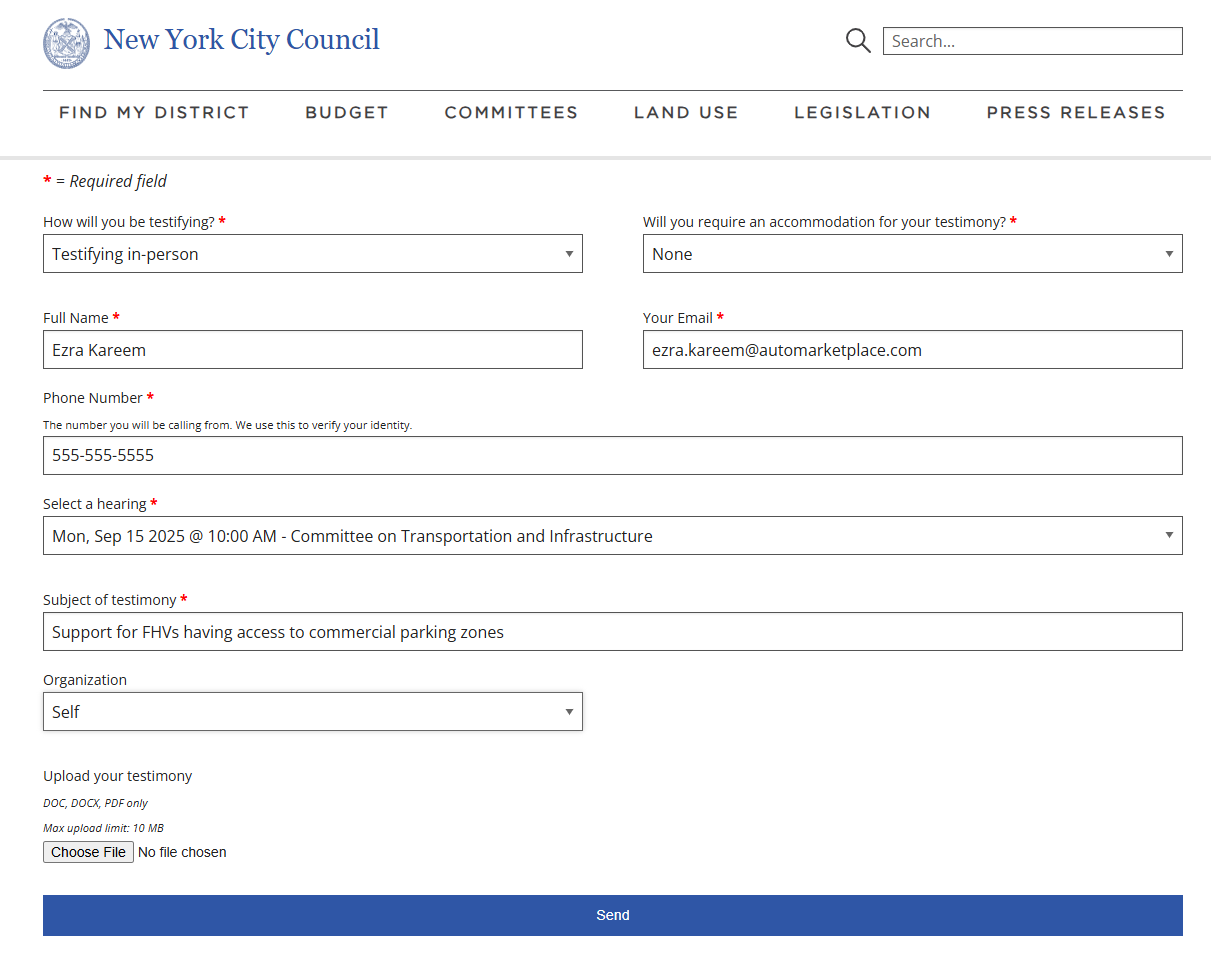
Yes. Members of the public can testify at City Council hearings and it does not require pre-registration, although it’s recommended.
You do not need to sign up to testify in advance for in-person meetings, but it is a good practice to sign up at least one business day before, no matter how you wish to testify (in person, phone, zoom).
Sign up here: https://council.nyc.gov/testify/.
What is NYC Council? Why is it important?
City Council is essentially the Congress, or legislative branch, of New York City. Its responsibilities include approving and overseeing the city budget, which reached $115 billion for the most recent fiscal year.
All City Council Members must win an election in their respective city district (currently 51 districts).
Notably, City Council Members, along with the Mayor and other elected city government positions, are limited to two consecutive, four-year terms. An individual can run again after a four-year term break where they are not holding the same office.
Ҥ 1137. Public Policy. It is hereby declared to be the public policy of the city of New York to limit the time elected officials can serve as mayor, public advocate, comptroller, borough president and council member so that there is more opportunity for citizen participation in the legislative and executive branches and the airing of a greater diversity of ideas. It is further declared that this policy is most appropriately served by limiting the time such officials can serve to not more than two consecutive full terms. It is further declared that public confidence in government should be protected by restricting amendments that would affect the application of term limits to any elected official then in office.
§ 1138. Term Limits. a. Notwithstanding any provision to the contrary contained in this charter, no person shall be eligible to be elected to or serve in the office of mayor, public advocate, comptroller, borough president or council member if that person had previously held such office for two or more consecutive full terms, unless one full term or more has elapsed since that person last held such office.”
The current distribution of City Council’s 51 Members, by borough, is:
16 from Brooklyn
14 from Queens
9 from Manhattan
8 from the Bronx
2 from Staten Island
1 from Manhattan / Bronx
1 from Staten Island / Brooklyn
Mayor / TLC vs. NYC Council
The Mayor, the “President of NYC” extending the Congress analogy, and their appointed deputies and commissioners (akin to a President’s Cabinet), represent the executive branch of city government.
TLC Chair & Commissioner David Do is not an elected official; he was nominated by Mayor Eric Adams. Adams, in turn, may have nominated Do based on a recommendation from his (former) appointed Deputy Mayor of Operations Meera Joshi, a previous NYC TLC Chair under former Mayor Bill de Blasio and current board member of Marblegate’s publicly-listed taxi medallion entity.
For example, before Do could officially lead the influential for-hire transport regulator he needed to be vetted and approved by City Council. Some of you might think the confirmation process is merely a formality, since the Mayor and City Council supermajority often belong to the same political party (Democrat).
This is not always the case. There was actually a TLC Chair nominee who couldn’t garner enough support in City Council in 2019. This failure then led to the appointment of Aloysee Heredia Jarmoszuk who resigned, after public controversy, which then led to the appointment of current TLC Chair David Do.
While City Council currently has only six Republican members, one must remember that within a political party there are different ideological subgroups that can disagree on policy. Some Democrats might have more economically liberal views, while others might be more moderate or conservative.
In addition, City Council Members could come into conflict with other policymakers over securing resources for their specific district or borough (i.e., Queens vs. Brooklyn) and also lobby for the unique demands of their constituents (i.e., district has a lot of residents who are NYC TLC drivers).
Article continues after advertisement

IDG to hold rally on FHV access to commercial parking space
The Independent Drivers Guild (IDG) will hold a rally on Monday outside of City Hall, where City Council hearings take place, at 9:15am.

Impact on TLC Plate (Taxi Medallion) valuations
We also want to note that, in our view, if FHVs—including yellow medallion cabs—gain access to NYC commercial parking spaces, it will have a positive impact on TLC plate and taxi medallion values.

As more of the city’s grid and curb space is reallocated away from vehicles and toward bikes, e-scooters, smaller delivery vans, and pedestrian-only zones, NYC curbside access rights will become increasingly valuable. This value stems from several factors.
For example:
Revenue protection: Legal curb access allows drivers to stage closer to high-demand pickup zones, increasing trip volume and reducing deadhead miles.
Asset support: Because TLC plates (and medallions) are directly tied to operating privileges, added access strengthens their market value, akin to airport curbside pickup rights.
Future AV environment: In a world of autonomous vehicles (AVs), designated staging areas will be critical for servicing vehicles (e.g., tire changes, sensor recalibration, or other quick fixes), further reinforcing the long-term value of NYC curbside rights.
AutoMarketplace reports on New York City’s for-hire transportation (TLC) industry and the wider automotive mobility landscape.
Check out AutoMarketplace on YouTube. Interested in advertising with us? Click here.