

NYC TLC Proposes Sweeping Reforms to Tighten Driver Licensing & Training Standards
An upcoming public hearing will review NYC Taxi & Limousine Commission proposals on stricter driver training, tougher licensing standards, and increased enforcement

The New York City Taxi & Limousine Commission (NYC TLC) has scheduled a public hearing for this Wednesday, December 17th at 10:00am to consider a wide-ranging overhaul of driver licensing, education, and conduct rules. The proposed changes signal a renewed regulatory push focused on accessibility, safety, and professional standards across the City’s taxi and for-hire vehicle (FHV) industry.
The Zoom-only hearing is seeking public comment on rules and amendments that would reshape how current and prospective TLC drivers are trained, tested, and evaluated. We strongly urge NYC TLC-licensed drivers to sign up and participate, as the outcome could have meaningful long-term implications for driver supply, earnings, enforcement, and professional standards.
How to sign up and participate in the NYC TLC public hearing?

The TLC’s public hearing will take place virtually on December 17, 2025 at 10:00 am via Zoom and will be livestreamed on the TLC’s website. Anyone wishing to testify must register in advance by emailing tlcrules@tlc.nyc.gov or calling 212-676-1135 by December 16th (tomorrow). Speakers will have up to three minutes, and no same-day signups will be accepted. Written comments may be submitted through the NYC Rules website, by email, fax, or mail, and must be received by December 17. Accessibility accommodations, including sign language interpretation and live transcription, must also be requested by December 16.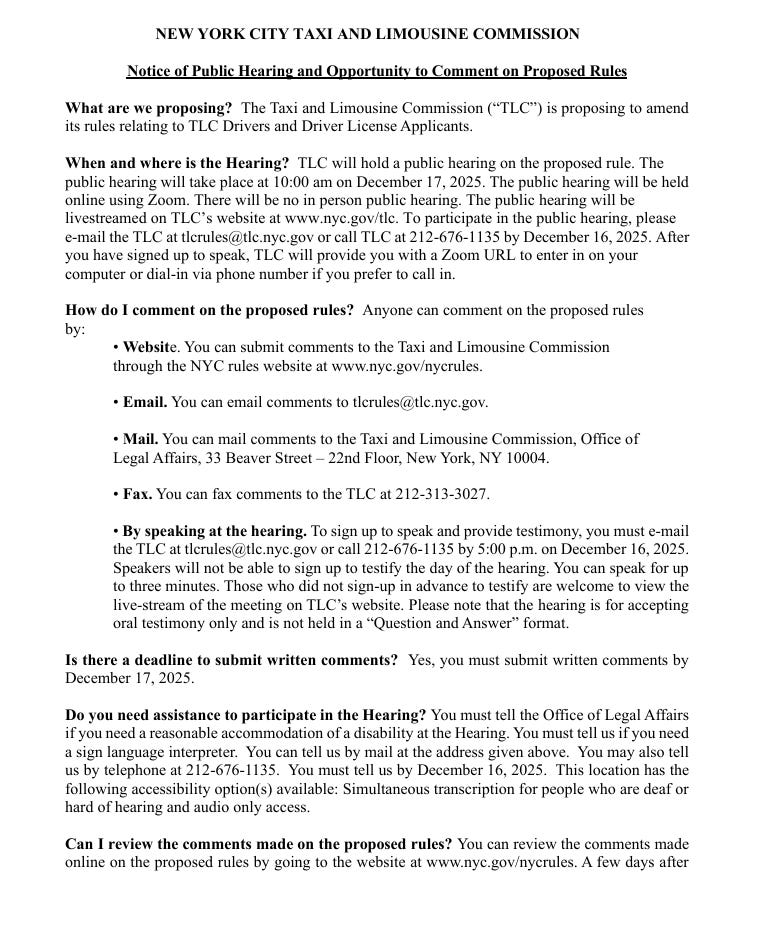
Accessibility and Service Refusals
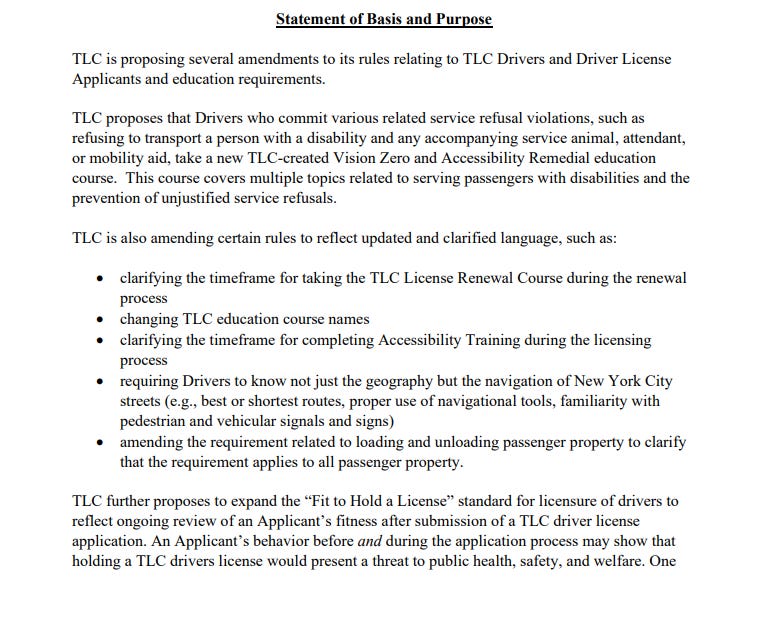
At the center of the TLC’s proposed rules is a tougher stance on accessibility and service refusal enforcement.
Drivers found guilty of refusing service to passengers with disabilities, including those accompanied by service animals, would be required to complete a new TLC-designed Vision Zero and Accessibility Remedial Education Course. Suspension would be deferred for 60 days and avoided entirely if the course is completed within that period.
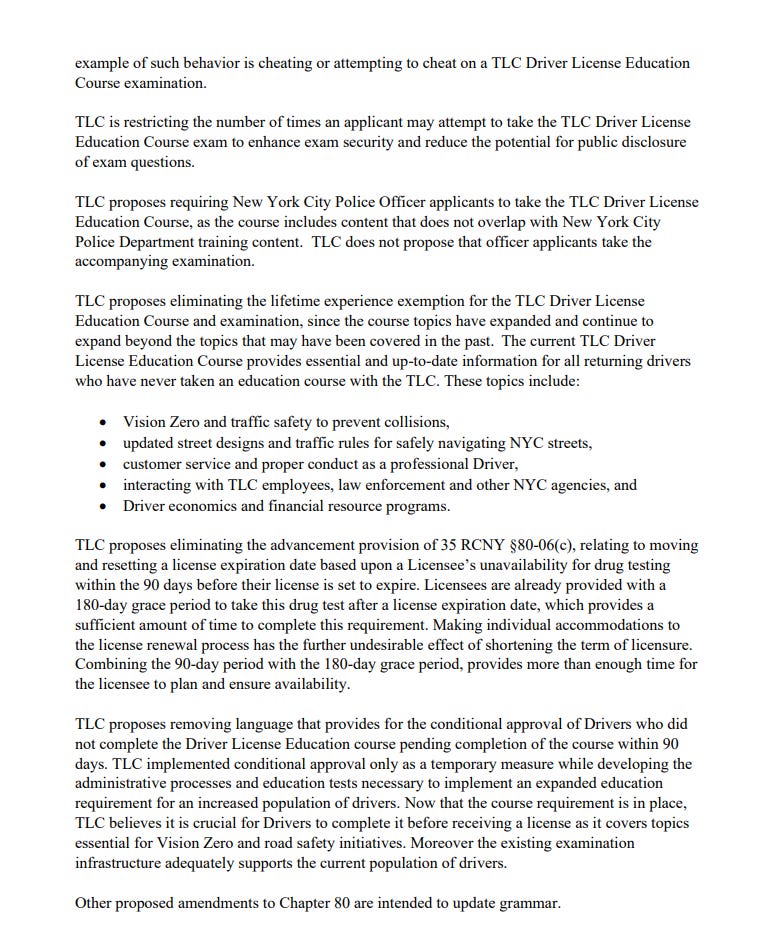
Tougher Exam, Lifetime Experience Exemption Removed, “Fit to Hold a License”
The rules also modernize what it means to be familiar with New York City geography.
Beyond basic map knowledge, TLC drivers would be required to demonstrate practical navigation skills, including route selection, proper use of navigational tools, and an understanding of pedestrian and traffic signals.
This shift reflects the regulator’s view that professional driving competency now extends beyond memorization and toward real-world navigation. Because the TLC driver license exam is derived from required education course content, this expanded standard would be taught through driver education and reflected in updated exam questions.
Several long-standing exemptions would also be eliminated, including the lifetime experience exemption from the TLC Driver License Education Course, which would require all returning drivers who have never completed the newer TLC course to do so.
The agency argues that today’s curriculum covers far more than in past decades, including Vision Zero, updated street design, customer service, and driver economics. Applicants would also be limited to three exam attempts within a 90-day window, a move aimed at protecting exam integrity.
Finally, the proposal broadens the TLC’s discretion to deny licenses based on conduct during the application process itself, including cheating on education exams, under an expanded “fit to hold a license” standard. Coupled with tightened rules around electronic device use, mandatory loading of all passenger property, and clearer renewal timelines, the rules package represents one of the most comprehensive changes to TLC driver regulation in recent years.
The rules also revise the technical names of certain courses, renaming the Distracted Driving Course to the Portable Electronic Device Course.
Early Public Pushback: Flexibility vs. Enforcement
Several concerns have already emerged in public commentary. One commentator, C. James Robert von Scholz, SC, who identifies himself as a Registered Representative before the Office of Administrative Trials and Hearings (OATH), warns that strict, non-discretionary compliance deadlines, particularly around remedial education courses, could trigger avoidable suspensions and income loss for drivers juggling multiple jobs or unpredictable schedules, absent limited extension or hardship accommodations.
He also notes that stricter exam limits and expanded discretionary standards, if interpreted too broadly or applied inconsistently, and if not paired with clearer guidance and due-process safeguards, risk excluding otherwise capable applicants who may need additional time or support rather than heightened enforcement alone.
Relatedly, he cautions that the expanded requirement to load and unload all passenger property, while fair in principle, would benefit from clearer definitions of what constitutes a reasonable and safe request to avoid penalizing drivers for refusing unsafe or impractical demands. These critiques do not reject the direction of the reforms, but instead call for modest flexibility, clearer definitions, and consistent application to ensure that professionalism is strengthened without producing unnecessary hardship.
Article continues after advertisement

Why These Changes Matter Beyond Compliance
Beyond the mechanics of licensing and enforcement, the proposed rules raise broader questions about how New York City wants its for-hire transportation workforce to function.
Are these standards intended to rebuild driving as a skilled, full-time profession, or will they unintentionally push marginal drivers out of the system altogether? That tension — between promoting the development of a full-time professional workforce that can earn a living wage and the ability, or right, to work — sits at the core of the public hearing, in our view.
One potential consequence of the proposed rules is a reduction in the number of licensed for-hire drivers in NYC, adding another layer of supply protection on top of the existing FHV License Pause (TLC Plate Cap). That dynamic could meaningfully improve driver earnings by restoring a healthier supply-and-demand balance. Stricter licensing and training standards may also produce a more actuarially sound driver base, probabilistically improving loss performance across the industry. A critical consideration given the ongoing financial distress at TLC insurance giant American Transit.
That said, the long-term success of this approach will depend on whether the regulator applies the new standards proportionally, with enough procedural flexibility to avoid turning compliance failures into automatic exits from the workforce.
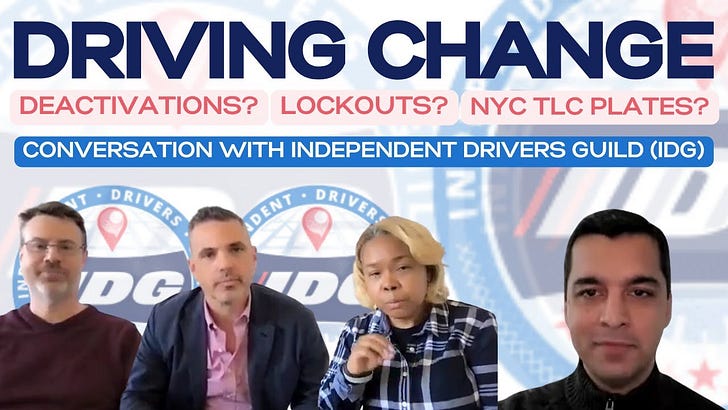
Driver advocates have long debated whether the City should impose a formal cap on TLC driver licenses. The Independent Drivers Guild (IDG), among others, has previously argued in favor of limiting TLC driver license issuance. While the current proposal does not establish a hard cap, it clearly moves in that direction — and, in our view, in a largely sensible manner.
Uber’s recent decision to activate drivers from its NYC waitlist, despite more than 2,500 inactive yellow cabs and utilization rates hovering in the mid-50% range for active app-focused drivers, underscores the need for regulators to take additional steps to prevent oversaturation from further eroding driver earnings. These rules, whether intentionally or not, may reduce the total number of active TLC-licensed drivers, in turn weakening Uber and Lyft’s leverage, which is largely driven by their monopolistic control over trip demand.
As we previously noted:
“The concept of a NYC TLC driver license cap is easy enough to understand. Instead of value accruing to a TLC plate or taxi medallion — essentially NYC for-hire vehicle licenses — a driver’s commercial license would become the scarce asset.
We understand the concept, but have concerns, which is why we think making a NYC TLC driver license harder to get or maintain (i.e., tougher exams, licenses going inactive if no recorded trip occurs within six months) is probably a better way forward.
Sticking with a limited FHV licensing regime should be preferred by the majority of drivers, particularly in light of the potential rise of autonomous vehicles (“AVs” or “robotaxis”).” — AutoMarketplace (December 8, 2024)
Viewed through that lens, the TLC’s current proposal represents a meaningful step toward reestablishing professionalism, skill, and accountability in the City’s for-hire transportation market, without imposing an excessively prohibitive licensing regime.
At the same time, existing and prospective drivers may argue that the expanded course requirements feel excessive. Others may contend that the proposals function, in part, as a revenue generator for TLC-approved driver education schools and the agency itself , particularly given the elimination of the lifetime experience exemption and the proposal requiring NYPD officers to complete the TLC Driver License Education Course. That perspective deserves to be part of the public record.
We look forward to hearing the public commentary, encourage drivers to sign up for the hearing, and will publish a summary once all written and spoken comments are released.
AutoMarketplace reports on New York City’s for-hire transportation (TLC) industry and the wider automotive mobility landscape.
AutoMarketplace.com is a data intelligence and market infrastructure platform for New York City’s for-hire vehicle ecosystem—delivering proprietary indexes (AYX, APX, AIX), real-time analytics, and marketing services across taxi medallions, TLC plates, and commercial insurance.
Check out AutoMarketplace on YouTube. Interested in advertising with us? Click here.