



At last week’s NYC Council’s Committee on Transportation and Infrastructure preliminary budget hearings, the Taxi & Limousine Commission (TLC) came in to present a fairly straightforward story: a ~$58 million budget, a recovering market, and steady progress across the industry.

The panel, led by Acting TLC Chair and Deputy Commissioner of Operations, People, and Innovation Evan Hines, alongside General Counsel Sherryl Eluto and Deputy Commissioner for Policy and Community Affairs James DiGiovanni, walked through what, at first glance, looked like a standard update.
But the discussion that followed told a more complicated story about chronic understaffing at the city’s for-hire transportation regulator, reduced enforcement capabilities, and increasing complaints against TLC drivers.
Introduction
Acting TLC Commissioner Evan Hines opened the hearing with a broad, fifteen-minute snapshot of how NYC’s for-hire transportation market has largely stabilized post-pandemic, although challenges remain.
Hines stated the TLC regulates nearly 300,000 licensees across commercially-licensed NYC drivers, taxis, for-hire vehicles, commuter vans, and bases, supporting over 320 million annual trips, up roughly 6% year-over-year . Yellow taxis have seen a partial rebound, while high-volume for-hire vehicles, or TLC-plated FHVs dispatched by Uber and Lyft, continue to dominate for-hire trip volume.

Driver earnings have increased meaningfully on a gross basis, though the acting Commissioner noted that rising costs—from insurance to fuel—continue to compress take-home net income. The agency highlighted persistent challenges, including congestion, insurance volatility, and a growing concern around illegal and unlicensed operators siphoning trips and creating safety risks.
While we see stability across the TLC’s regulated industries, we continue to see and address unlicensed activity, which not only siphons off trips from licensed drivers and bases who follow city rules, but also endangers and exploits passengers…This is an issue that TLC has consistently been addressing.
Hines also walked through several policy initiatives impacting the industry.
On electrification, the TLC is pushing forward with the Green Rides Initiative, approaching its target of having 25% of high-volume (HV) app trips dispatched to electric vehicles (EVs) or wheelchair accessible vehicles (WAVs) in 2026. He also noted comments from TLC Chair-nominee Midori Valdivia regarding the potentially prohibitive costs associated with meeting Green Rides targets.
According to [Green Rides] rules, by this year, 25% of all high volume [Uber and Lyft] for hire vehicle trips must be dispatched to electric or wheelchair accessible vehicles. Our newly nominated chair and chief executive officer highlighted in her testimony before the [City] Council that the costs associated with this public good has largely been borne by drivers and small businesses and is something that TLC should further review. We fully expect the companies to meet these requirements and they are on track with a current industry average of 22.7%.
Hines also noted a series of recent local laws driving additional changes in the TLC market—from requiring cyclist safety decals to a forthcoming report on EV infrastructure and incentives, to reforms that cap personal injury protection (PIP), or no-fault, insurance requirements.
Accessibility also remains a central focus, with more than 58% of the yellow taxi fleet now wheelchair accessible. But that progress has required tradeoffs: the agency moved away from its centralized Accessible Dispatch system that cost roughly $6 million annually, shifting instead to an app-based model while expanding incentives through the Taxi Improvement Fund (TIF). Programs like ATLAS also aim to further support taxi fleet conversion to WAVs through low-cost financing.

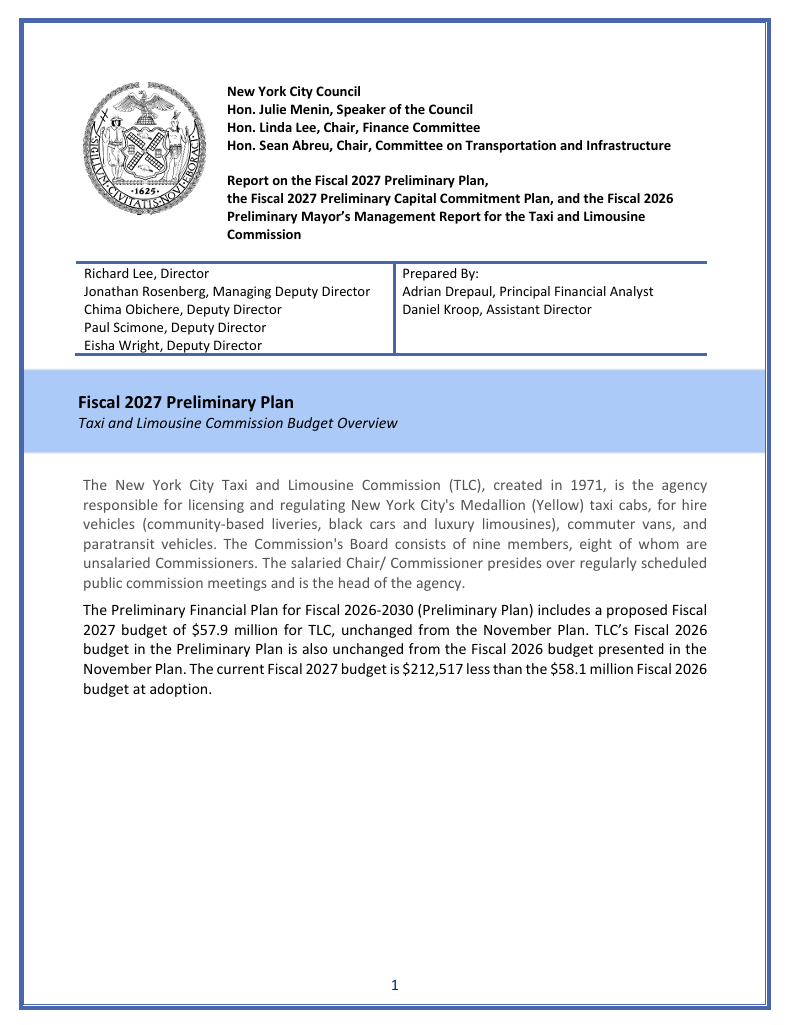
Finally, Hines turned to the agency itself—its budget, staffing, and infrastructure. The Taxi and Limousine Commission’s preliminary FY2027 budget stands at approximately $57.9 million, a modest decrease tied in part to reduced medallion relief funding.
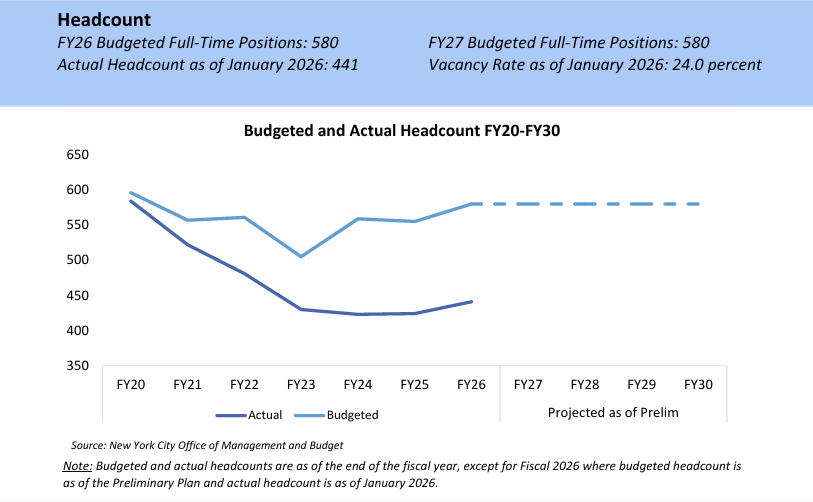
Authorized headcount for TLC is 546, though the agency continues to face high attrition, particularly within its enforcement-focused Uniformed Services Bureau. While recent hiring has reduced vacancy rates significantly, staffing remains a core operational focus.


On the infrastructure side, TLC is entering the second phase of a $180 million reconstruction of its Woodside inspection facility, which will expand capacity and offer electric vehicle (EV) charging.
Taken together with the City Council report, Hines’ presentation underscored that the TLC is functioning and evolving but is significantly understaffed and increasingly reliant on continuous operational adjustments to keep pace with the scale and complexity of the marketplace it regulates.
Article continues after advertisement

Rising Complaints Against TLC Drivers
While not mentioned during the regulator’s formal presentation, City Council Majority Leader and Chair of the Committee on Transportation and Infrastructure Shaun Abreu pressed the agency on a steady increase in complaints against TLC drivers, and whether those trends were connected to staffing shortages.
Over the past several years, complaints have risen meaningfully, reaching more than 28,000 annually in 2024 and continuing to climb in recent reporting periods. Abreu framed this directly as a concern about rider experience and safety.
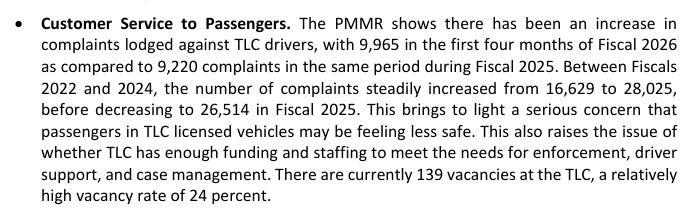
TLC’s response focused on scale and operations. Officials pointed to a surge in activity—more vehicles returning to the road, more trips per vehicle, and overall higher utilization—as a key driver of increased passenger complaints.
The agency also emphasized that internal process improvements have reduced response times significantly, allowing the regulator to reach complainants faster and convert more complaints into actionable cases.
But the staffing question lingered. While TLC maintained that it currently has sufficient resources to manage enforcement and case processing, the data suggests a more constrained reality. The agency has operated with elevated vacancy rates for several years, particularly in its Uniformed Services Bureau (enforcement) and prosecution units. Acting Commissioner Hines did note progress—vacancy rates have improved from roughly 30% to closer to 13% following recent hiring efforts—but also acknowledged ongoing attrition and continued gaps in these critical roles.
At the ground level, one council member pointed to what these trends look like in practice. Queens Council Member Phil Wong cited frequent constituent complaints about aggressive driving, including speeding, running red lights and stop signs, and other unsafe behavior. TLC reiterated that complaints filed through 311 are taken seriously and can lead to escalating penalties, from fines and mandatory education to license suspension or revocation based on accumulated DMV and TLC points.
Taken together, the exchange highlighted a central tension: complaints are rising alongside activity, and while TLC has improved its ability to process them, enforcement capacity, particularly in staffing, appears to be a limiting factor.
Drivers Need Bathroom Access
We also thought it was worth mentioning Council Member Phil Wong comments on drivers not having reliable access to bathrooms.
In response to Wong’s question, TLC pointed to more than 100 designated taxi relief stands across the city, often located near restaurants or commercial areas where drivers can informally access restrooms . But Wong pushed back, noting that this system depends largely on the goodwill of private businesses and doesn’t guarantee access.
So, for example, in Manhattan, there might be a taxi relief stand near a lot of restaurants that drivers go to. (NYC TLC, DiGiovanni) Yeah, I get it. I get it. They will go into the restaurants or businesses and ask, may I use the bathroom? This is closely tied to the public bathroom problem of New York City that go back, even when I was a kid. (Phil Wong, City Council Member)
The exchange highlighted a broader gap. While policy discussions focus on electrification, accessibility, and enforcement, basic working conditions for drivers remain largely unaddressed. Wong suggested that TLC could work with the city, and potentially seek funding, to expand dedicated restroom access for drivers.
Also available on YouTube ⬇️
TABLE OF CONTENTS
00:00 TLC panel sworn in
00:56 Introduction: NYC TLC market update
11:18 $58 million preliminary budget & staffing overview
15:29 City Council Q&A: Driver health programs
17:44 Rising complaints against NYC TLC drivers (Part 1)
21:37 Accessibility-related Q&A, Accessible Dispatch program
28:06 Electric vehicle (EV)-related Q&A, charging infrastructure
31:15 Revenue from taxi licenses? Increase or decline in drivers?
33:19 TLC staffing issues
35:26 Rising complaints against NYC TLC drivers (Part 2)
38:40 Green Cab and Uber, Lyft accessibility rates
42:20 Drivers need bathroom access
45:00 Rising complaints against NYC TLC drivers (Part 3)
47:04 Closing remarks
AutoMarketplace reports on and invests in New York City’s for-hire transportation (TLC) industry and the wider automotive mobility landscape.
AutoMarketplace.com is a market intelligence and fleet management platform for New York City’s for-hire vehicle ecosystem—delivering proprietary indexes (AYX, APX, AIX), real-time analytics, and fleet services across taxi medallions, TLC plates, and commercial insurance.
Check out AutoMarketplace on YouTube. Interested in advertising with us? Click here


