

Dampower: The App That Beats Uber & Lyft on Price (Don't Ask About the Taxes)
Empower's pricing advantage is real. So are MTA surcharges, sales tax, and Black Car Fund contributions that fund NYC transit and driver benefits. If Empower doesn't owe them, guess who does?


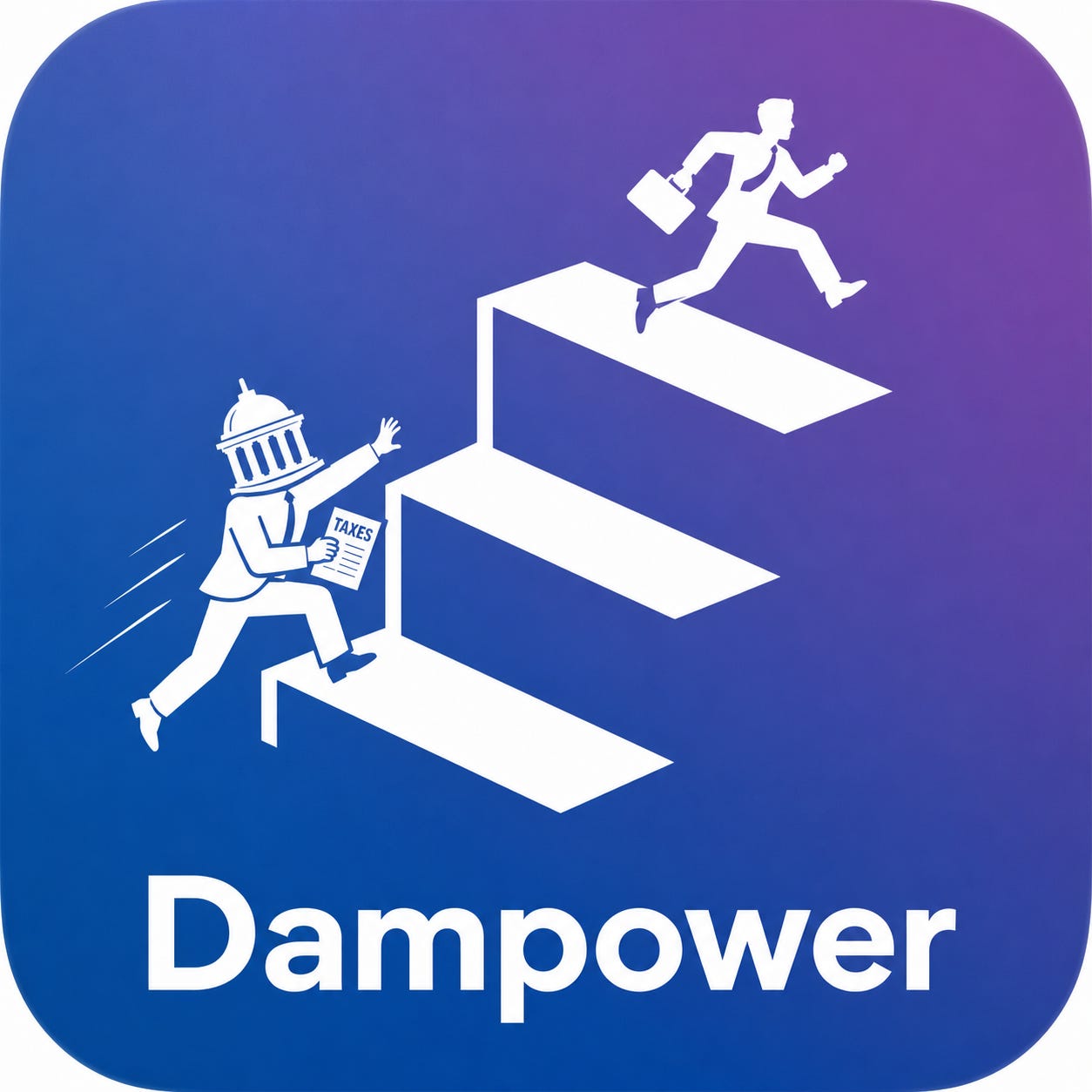
Imagine we started a new NYC ridehailing app. Let’s call it Dampower.
The pitch to drivers:
Flat monthly subscription, starting around $150
Zero commission
Keep 100% of every fare
The pitch to passengers:
Much cheaper than Uber and Lyft
Similar wait times
Same drivers and vehicles
With a functional app and decent marketing, we could hopefully drive a few thousand downloads. If we executed really well, Dampower might get a lot more than that.


As you might have guessed, Dampower is Empower, and they have executed really well: a 4.8 rating across 62,000+ reviews on the App Store and more than 100,000 downloads on Google Play with a similar rating. That sounds like a resounding success story, a real alternative to the Uber and Lyft duopoly that has defined our current era of for-hire transportation.
So why are regulators, politicians, journalists, the Taxi and Limousine Commission (TLC), even the MTA, seemingly hell bent on shutting this app down in New York City?


Stay with Dampower for one more minute and the answer becomes obvious.
Dampower’s Legal Theory
At Dampower, we believe that because we charge a flat subscription instead of a per-trip commission, we are a software product, not a transportation company. Yes, we do exactly what Uber and Lyft do, connect paying passengers to NYC TLC-licensed drivers. But our business model, we argue, exempts us from MTA and Black Car Fund (BCF) surcharges, sales tax on trips, licensing and data rules, and driver minimum pay standards. Specifically, we are not obligated to collect these surcharges and taxes, build them into passenger fares, and remit them to the state and city, the way Uber and Lyft do. As for insurance, TLC drivers carry their own commercial liability coverage, so every trip we send is fully insured (probably, but please consult your carrier documents).
To be clear, we are not saying those obligations aren’t real. We’re saying they aren’t ours. We are a software subscription, like QuickBooks. QuickBooks doesn’t remit your sales tax for you. Also, we’ve tried to work with New York to sort out what’s owed, but they don’t seem to want our help or money.
Frankly, we suspect Uber and Lyft are lobbying to kill Dampower. Our drivers and passengers stand with us against the corporate goliaths and the literal government. Regulators have even threatened our founder with jail time. Like the great “troublemakers” of history, she is willing to sit in a cell for the mission.
Cheaper rides for all. Better pay and dignity for drivers. Dampower!
Article continues after advertisement

No One Likes Paying Taxes, But You Should Pay Yours
The story of Dampower is the real-life story of Empower, and this week it made the tabloids. The New York Post reported that Empower’s unlicensed operations have cost the MTA millions in congestion pricing revenue. City Council Majority Leader Shaun Abreu, who currently chairs the Council’s transportation committee, called for the company to be held accountable, saying congestion pricing rules are supposed to apply fairly to everyone.
To the average person, the enforcement campaign can seem unfair. Empower offers drivers better money and passengers cheaper trips. Why is New York City trying to shut that down, especially in a market dominated by Uber and Lyft?
We’ve covered the nitty gritty of taxes and remittances before, and even helped put together a dedicated podcast on sales tax (!). We encourage you to read and listen to those details. For those who don’t have the time, here’s the quick explanation of why Empower is so controversial:
It’s not paying the taxes it owes. That’s it.
The martyrdom framing falls apart on contact with the details. Nobody is being persecuted for innovation. The dispute is over unremitted taxes and surcharges.
Take the congestion charges at the center of the Post story. Licensed taxis and for-hire vehicles are exempt from the $9 Congestion Relief Zone toll that private cars pay. Instead, passengers pay per-trip charges that the dispatching entity collects and remits: the $2.75 New York State congestion surcharge on for-hire trips below 96th Street, plus the $1.50 Congestion Relief Zone per-trip charge for trips below 60th Street. That’s $4.25 per qualifying trip. On Uber and Lyft receipts, these appear as line items. On Empower trips, they simply aren’t collected.
Now do the math. Empower’s CEO testified to over 100,000 NYC rides per week back in March, and volume is reportedly closer to 250,000 per week today. That’s roughly 1 million trips per month. If every trip qualified for the full $4.25, that would be about $4.25 million per month, or over $50 million a year, in uncollected congestion charges alone. Even if only half of those trips touch Manhattan’s congestion zones, you’re still looking at more than $25 million a year that never reaches the MTA. And that’s before counting the 8.875% sales tax and Black Car Fund contributions on every fare. “Millions in lost transit revenue” isn’t hyperbole. It may be an understatement.
If Empower Doesn’t Owe It, Who Does?
Here’s the part that should concern drivers most.
Let’s say Empower wins every argument. Let’s say a court agrees it is simply a software subscription that doesn’t owe the sales tax, the MTA surcharges that help fund city subways and buses, or the BCF contributions that fund workers’ compensation and benefit programs for TLC drivers.
Empower is not arguing these amounts aren’t owed. It’s arguing they aren’t owed by Empower.
If Empower doesn’t owe them, guess who does? The obligations don’t vanish. They attach to the only other party in the transaction (assuming the state is not coming after passengers!). Individual drivers would be responsible for registering, calculating, tracking, and remitting sales tax, MTA surcharges, and BCF contributions on every trip. Exposure that isn’t visible today can arrive later, through audit or enforcement action.
This is not hypothetical. This week, Empower’s own X account confirmed it pays 8.875% on its revenue, which we take to mean its subscription revenue, while describing the taxes on the rides themselves as fees “that riders should pay.” This is the equivalent of asking someone who bought an item on Amazon to remit the sales tax directly to the state, rather than Amazon collecting it at checkout and doing that work. Amazon collecting is obviously the efficient and accepted way. No one files their own sales tax return after buying sneakers.


The same logic follows an accident. On a trip not dispatched by a licensed TLC base, as a senior NYC taxi and for-hire vehicle insurance executive told us in February, unlicensed dispatch activity could be treated as material misrepresentation, grounds for policy cancellation, non-renewal, or premium reclassification. The workers’ compensation coverage normally funded through the Black Car Fund may simply not respond. In a market where most TLC drivers effectively have two primary liability options, non-renewal is not an inconvenience. It can end a driver’s ability to operate.

In New York City, compliance is not a cost of doing business. It is the condition for doing business. When a company structures itself so that the costs of compliance land on someone else, the someone else is not Uber, not Lyft, and not the MTA.
It’s drivers.
Latest from AutoMarketwire
Judge orders rideshare app Empower to halt Maryland operations (The Baltimore Banner)
Legal Bay Lawsuit Funding Says Access to Justice—Not Litigation Funding—Should Remain the Focus in Uber Lawsuits (PR Newswire via Morningstar)
Rideshare company with no NYC license has been conning congestion pricing and ditching millions in tolls: official (New York Post)
Brooklyn jury to decide whether Uber drivers are contractors or employees in car crash suit (amNewYork)
A Luxury Taxi Company Wants to Stop New York From Tracking Its Wealthy Riders (The Wall Street Journal)
Latest from AutoMarketplace:
Federal Judge Blocks NYC Driver Deactivation Law. DCWP’s $73 Million Expansion On Hold
David Do on Uber Lockouts, Driver Pay, TLC Plates, Taxi Medallions & AVs
AutoMarketplace is the largest newsletter and podcast covering NYC’s $16 billion for-hire transportation market — tracking commercial insurance, TLC plates, taxi medallions, and trips. Proprietary indexes: AIX, APX, AYX.
I believe even with sales tax, bcf and other fees the price for passengers would still be cheaper than uber/lyft and drivers would also get more money.
Do u know about the Obi app? It shows you most prices on different apps and car service. Recently they put Empower and its always the cheapest options. Most passengers and some drivers still are not aware that Empower is not a legal base in nYc.
NYC MTA is the biggest corrupt gangster in the country! The NYS , NYC government is another corrupt mafia. $9 to come to the city and this money go to packet of MTA! MTA and government promises improve infrastructure when starting collection of ripoff tolls! What improvements? The city roads are in the mess right now. Just look at Madison Ave what another communist clueless mayor did .I wish Empower good luck