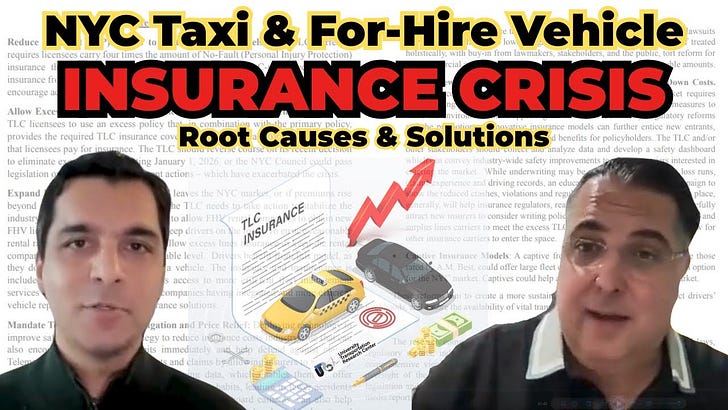
To the new or outside observer, NYC’s taxi and for-hire vehicle (“TLC”) insurance crisis might be seen as a sudden shock, triggered by the insolvency of American Transit Insurance Company (ATIC). The reality is far more complex and structural.
What the City’s TLC insurance industry is experiencing today is the delayed consequence of decades of underpricing, regulatory inaction, and market instability that accumulated until the system could no longer hide or absorb the strain.
In this episode, AutoMarketplace’s Dawood Mian speaks with Cira Angeles, CEO of L.A. Riverside Brokerage. Ms. Angeles is one of the most experienced figures in New York City’s for-hire vehicle (FHV) insurance and livery ecosystems. Angeles entered the industry in the mid-1990s, continuing the work her father began in the livery, or community car service, sector, and has since spent nearly thirty years operating as an insurance broker, base operator, fleet owner, and influential industry advocate.
Few people possess her institutional knowledge, institutional memory, and firsthand exposure to the NYC TLC insurance marketplace.
Drawing on that experience, Angeles explains how TLC insurance evolved from a competitive market with multiple carriers into one increasingly dependent on a shrinking pool of insurers. She details the rise of assigned risk, the repeated pattern of insurers entering the market only to exit a few years later, and the eventual dominance of American Transit as other carriers proved unable to sustain long-term underwriting discipline. A key takeaway is that TLC liability insurance prices have remained largely unchanged for decades, even as vehicle and driver counts, claims severity, fraud exposure, and regulatory complexity increased dramatically.

The conversation also examines how the arrival of Uber and Lyft accelerated existing weaknesses in the system. Rapid fleet expansion, younger and less experienced drivers, and aggressive competition for market share and broker fees undermined underwriting standards across the industry. When losses finally emerged, they surfaced years later, at a scale that exposed the absence of adequate reserves, slow regulatory response, and insufficient competition. As Angeles emphasizes, rate increases alone cannot repair a system whose problems are rooted in solvency, fraud control, and delayed policy reform.
The episode concludes by looking forward, focusing on what it will take to stabilize the TLC insurance market without dismantling the broader transportation ecosystem that supports hundreds of thousands of New Yorkers. From the need for better data and analytics to the risks of premature reliance on autonomous vehicles (AVs), the discussion is grounded, unsentimental, and solutions-oriented.
This is not a conversation about blame, but about understanding how the system actually works and what it will take to make it sustainable.
We hope you enjoy the conversation, and we thank Cira for her time.
Also available on YouTube ⬇️
Table of Contents
00:00 – Cira Angeles’ background & L.A. Riverside origins
02:16 – Entering NYC TLC insurance market, focusing on livery sector
04:29 – Livery vs. Black Car industry, explained (10/90 vs. 90/10)
06:30 – What TLC Insurance looked like in the 1990s
07:09 – Understanding assigned risk insurance (state-mandated/backed program)
08:15 – TLC underwriting subcategories — yellow cab medallion, black car, livery
11:25 – TLC insurance rates and dynamics through the 1990s and mid-2000s
14:20 – TLC insurance rates haven't changed in 25+ years
16:10 – Rise of American Transit, decline of competition
16:58 – Why Insurers Kept Entering — and Leaving ("Give them three years...")
19:30 – How did American Transit survive?
24:09 – TLC insurance rates and dynamics preceding rise of Uber/Lyft
25:25 – Difference in Livery vs. Black Car insurance rates, Black Car Fund (BCF), Independent Livery Drivers Benefit Fund (ILDBF), rise of cross-class dispatching
31:11 – Importance of understanding assigned risk dynamics and pricing
34:36 – How Uber & Lyft changed NYC TLC insurance
41:30 – American Transit's historic $670+ million insolvency and the path forward (not just rates)
46:45 – Addressing fraud, need for capital, and bureaucracy
49:30 – Would it help if market shrank (e.g., TLC plate / driver attrition)? (Part 1)
51:35 – Personal auto liability vs. TLC commercial auto rates in NYC
53:00 – Would it help if market shrank (e.g., TLC plate / driver attrition)? (Part 2)
1:01:40 – Are new TLC insurance options coming soon?
1:08:05 – Risk that American Transit loses better risk drivers to competition (Hereford), makes insolvency worse?
1:11:20 – L.A. Riverside: upcoming March 2026 renewal season, growing base business
1:17:40 – Is it a good time for a new TLC insurance company?
1:21:22 – Autonomous Vehicles (AVs): threat, distraction, opportunity?
1:30:00 – Final Thoughts
AutoMarketplace reports on and invests in New York City’s for-hire transportation (TLC) industry and the wider automotive mobility landscape.
AutoMarketplace.com is a data intelligence and market infrastructure platform for New York City’s for-hire vehicle ecosystem—delivering proprietary indexes (AYX, APX, AIX), real-time analytics, and marketing services across taxi medallions, TLC plates, and commercial insurance.
Check out AutoMarketplace on YouTube. Interested in advertising with us? Click here.