To most observers, New York City’s electric vehicle (EV) charging problem is straightforward: too many EVs and not enough chargers.
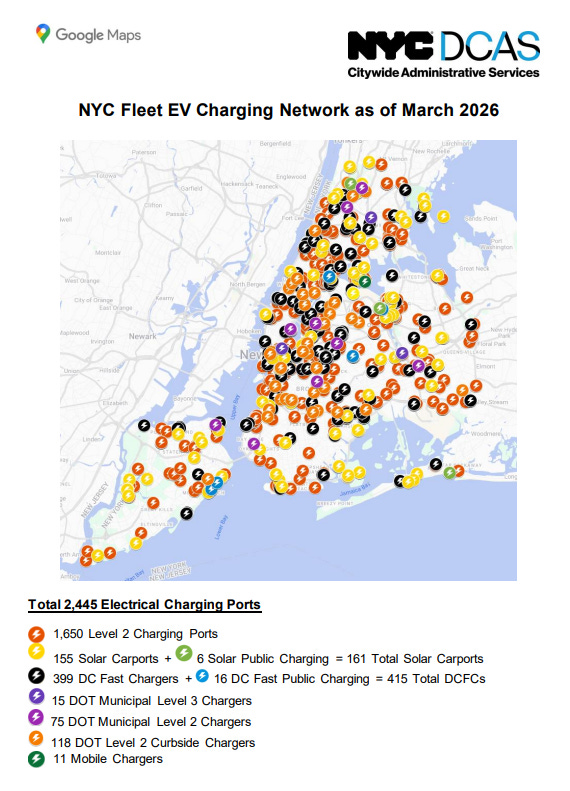
To be specific, among the 115,179 taxis and for-hire vehicles (FHVs) in the city’s fleet, 13,146 are EVs. However, there are only 415 DC “Level 3” fast chargers located across the five boroughs. These chargers must also be shared with 33,537 passenger EVs registered in the five boroughs, though some private owners may have home charging, as well as thousands of commercially used EVs registered to New York City addresses.

However, the reality is more complex.
In practice, the challenge is not simply the total number of chargers, but where they are located and how they are used. Charging demand tends to cluster around certain neighborhoods and times of day, creating what some describe as a “peak problem.”
As a result, infrastructure planning is increasingly focused not only on adding chargers, but placing them in locations where utilization will be highest.
What many drivers experience today as long waits at charging stations reflects not only infrastructure constraints but also the early-stage dynamics of a fragmented and rapidly evolving charging ecosystem.
In today’s podcast episode, AutoMarketplace’s Dawood Mian speaks with Ashwin Dias, Co-Founder and CEO of Presto Charging.
Dias previously spent nearly eight years at Uber, where he helped build and scale several business units and helped lead the company’s global electrification and vehicles program, focusing on helping drivers transition to EVs and lowering barriers to adoption across different markets.
Through that work, Dias saw firsthand that one of the most persistent obstacles to electrification was not simply the cost of vehicles, but access to reliable charging. Ride-hail drivers based in densely populated cities, in particular, rely heavily on publicly accessible charging infrastructure, since most do not have access to private garages or home charging.
Presto, which raised $15 million in seed funding last year from Union Square Ventures, Congruent Ventures, Powerhouse Ventures, and Jetstream, was founded by Dias and J.J. Raynor to address this problem.
Advertisement

Rather than building charging stations, Presto operates a marketplace and aggregation platform designed to unify a fragmented EV charging ecosystem.
For drivers, especially high-mileage for-hire vehicle and taxi drivers who depend heavily on publicly accessible charging, navigating that ecosystem can be inefficient. Today, dozens of charging networks operate across the United States and New York, each with its own apps, pricing systems, and availability data.
Presto connects multiple charging networks through a single interface, allowing drivers to locate available chargers, compare prices, and initiate charging sessions without switching between numerous apps.

The objective is not only convenience, but efficiency.
Utilization sits at the center of charging economics. In theory, a fixed number of chargers could serve a large fleet if demand were evenly distributed throughout the day. In practice, drivers tend to charge during similar windows—between shifts, after long driving sessions, or during slower demand periods—creating predictable spikes. These peaks can produce waiting lines even when total capacity might otherwise be sufficient, particularly in dense cities like New York where high-mileage FHVs rely heavily on fast chargers.
Fast charging infrastructure is also expensive. A single Level 3 charger can cost more than $100,000 before installation and electrical upgrades. With such high fixed costs, profitability depends largely on utilization: frequently used chargers spread infrastructure costs across more charging sessions, while poorly located chargers can sit idle. The challenge, therefore, is not simply adding chargers but placing them where drivers actually need them, near airports, taxi and FHV staging areas, commuter corridors, or dense residential neighborhoods.
Investors and other stakeholders must also account for technological change. Charging speeds continue to improve, meaning hardware installed today may have shorter useful lives than traditional infrastructure. Yet much of a site’s long-term value lies in the electrical capacity itself — the grid connections and utility upgrades required to deliver high power — which remain valuable even as charging equipment evolves. And unlike gas stations, charging does not always require large standalone facilities. As Dias notes, “Today, it’s easier to charge an EV in Manhattan than it is to fill it up with gas.”
Over time, the ecosystem may evolve into a hybrid model. Fast Level 3 chargers will continue serving drivers who need rapid turnaround during the workday, particularly NYC TLC-licensed vehicles that accumulate hundreds, sometimes thousands, of miles per week, while a growing network of Level 2 chargers in neighborhood garages could provide what Dias describes as “near-home charging” overnight.
Simply put, New York City does need more chargers. But drivers also need better tools to use the existing network effectively. Visibility into charger availability, smarter routing, and better coordination across charging networks can help reduce congestion and waiting times, ensuring that the infrastructure already in place works as efficiently as possible. This will help EV adoption grow naturally within the TLC fleet, with no mandates necessary.
We hope you enjoy the conversation!
Ashwin can be reached at a@prestocharging.com.
Download the Presto Charging app here.
Also available on YouTube ⬇️
TABLE OF CONTENTS
00:00 Introduction
00:40 Ashwin Dias’ Background at Uber
03:58 Uber’s Electrification Program Explained
06:35 Why Ashwin Left Uber to Start Presto
07:43 The Fragmented EV Charging Ecosystem
10:30 How Presto Works as a Charging Marketplace
13:46 NYC’s EV Charging Infrastructure Problem
16:17 NYC TLC Drivers vs Personal EV Charging Needs
18:40 Why Drivers End Up Waiting for Chargers, NYC-specific problem?
23:19 How Marketplaces Can Improve Charging Utilization
27:00 The Economics of Building EV Charging Stations
29:26 NYC Real Estate Impact on EV Charging Buildout
32:00 Live Demo of the Presto Charging App
45:00 Is EV Charging a Good Business?
48:12 Gas Station, Convenience Store Business Model
50:15 Battery Swapping vs Fast Charging
52:12 EV Charging Investment and Obsolescence Risk(s)
54:00 What Policymakers Can Do to Improve EV Charging Availability
57:22 Thoughts on NYC TLC Drivers Adopting EVs
01:00:45 Autonomous Vehicles (AVs) and the Future of Charging
01:05:00 What NYC EV Charging Could Look Like in 10 Years
AutoMarketplace reports on and invests in New York City’s for-hire transportation (TLC) industry and the wider automotive mobility landscape.
AutoMarketplace.com is a data intelligence and market infrastructure platform for New York City’s for-hire vehicle ecosystem—delivering proprietary indexes (AYX, APX, AIX), real-time analytics, and marketing services across taxi medallions, TLC plates, and commercial insurance.
Check out AutoMarketplace on YouTube. Interested in advertising with us? Click here